⚡ Fast Response | Expert Repairs | Trusted Service
MOBILE HOME REPAIRS
Water Damage & Plumbing Repairs
Mobile Home Emergency Repairs
At Homesaver Remodeling, we provide comprehensive emergency repair services exclusively for manufactured and mobile homes across Michigan. Backed by 15 years of experience and over 350 completed projects, we handle urgent water damage, storm restoration, mold remediation, and wildlife damage repair. Because manufactured home materials work on a faster timeline when compromised, our expert team focuses on securing your home immediately, tracing hidden damage, and fixing the root cause using industry-specific materials.
Emergencies in mobile and manufactured homes don't follow the same timeline as they do in site-built construction. Water gets into a subfloor and spreads within days. A storm tears open a section of roof and the insulation underneath is soaked before the weather clears. Mold establishes itself in a crawlspace and works upward through materials that aren't designed to resist prolonged moisture exposure. When something goes wrong in a manufactured home, the window for a manageable repair closes fast.
Homesaver Remodeling works exclusively with mobile and manufactured homes across Michigan. With 15 years of experience and 350 completed projects, we know how these homes are built, where damage moves inside them, and what it takes to fix it properly the first time. When you call us for an emergency, we find the source before we start the repair.
Emergency Water Damage Repair
Water damage is the most common emergency we respond to, and it's also the one that spreads the fastest inside a manufactured home.
Crawlspace flooding from ground saturation or drainage failure
Where Water Goes
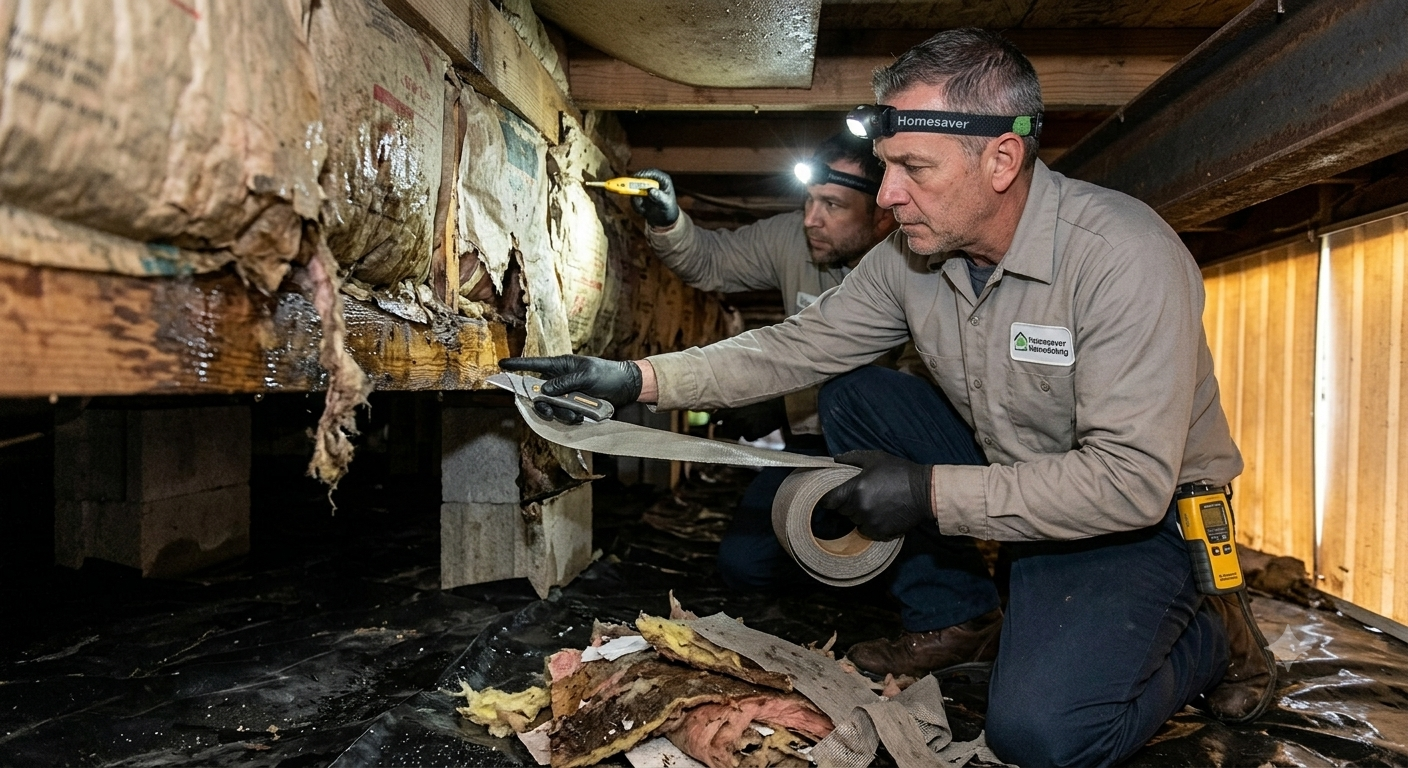
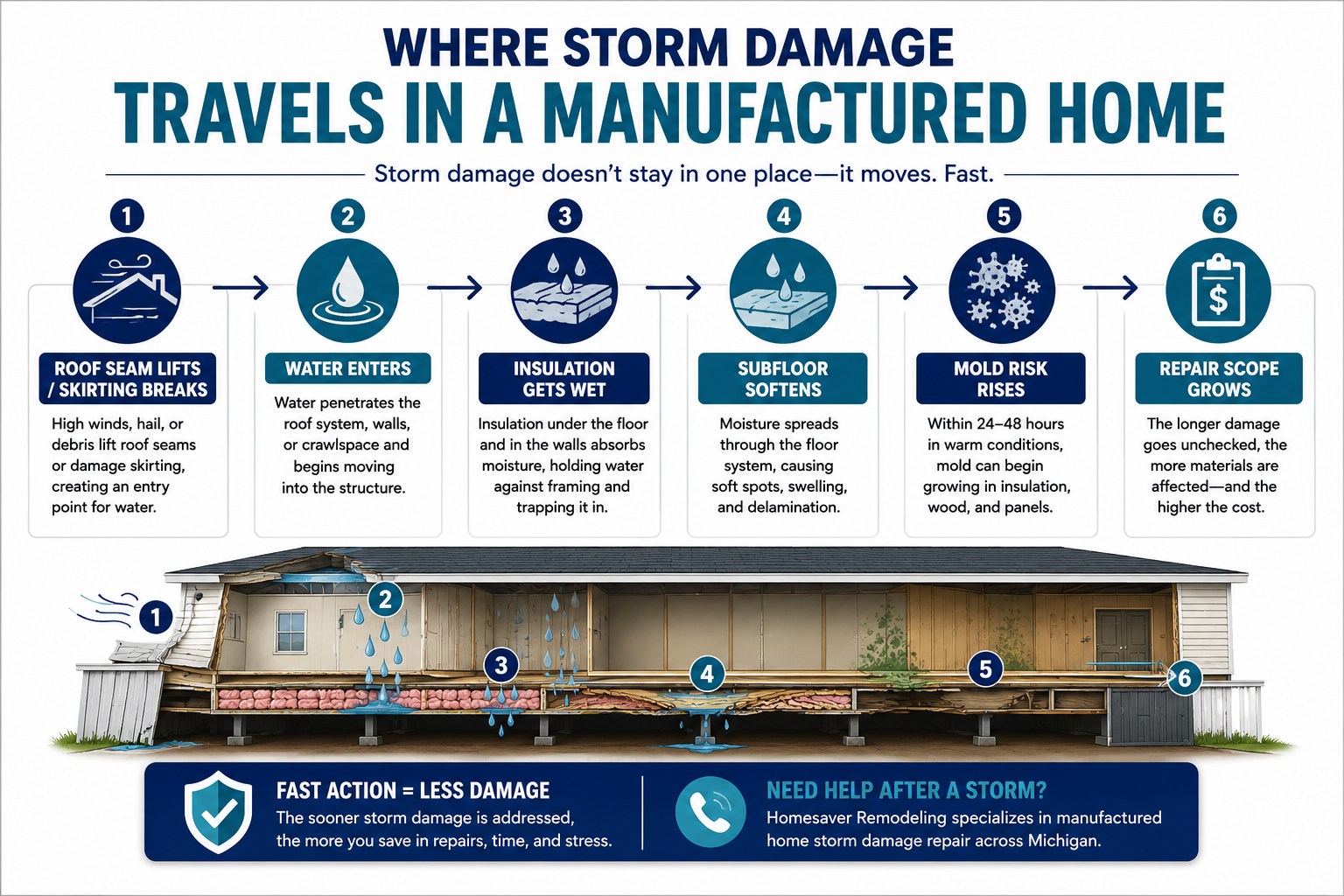
Water that enters a manufactured home doesn't stay in the room where it started. It moves under the floor into insulation, saturates the subfloor from below, and can work its way into wall cavities before there's any visible sign at the surface. By the time a homeowner notices soft flooring or water staining, the moisture has often already spread several feet beyond the visible damage.
What Our Response Involves
We assess the full scope of the moisture intrusion before any repair work begins, using the construction layout of the home to trace where water traveled. From there, the process includes moisture elimination, removal of compromised materials, subfloor and structural repair as needed, and correction of the source. Drying out the visible area is not enough. Materials that have absorbed significant moisture need to be replaced, not dried in place.
Manufactured Homes vs. Site-Built Homes After Storm Damage
Storm damage affects every home differently. Manufactured homes have unique construction systems that often allow damage to spread faster and further than homeowners realize.
Area
Site-Built Home
Manufactured Home
Roof Systems
Heavier framing often limits damage to the impacted area.
Roof seams, membrane systems, and lighter framing can allow water intrusion to spread quickly.
Water Intrusion
Water often remains localized longer before spreading.
Water frequently travels laterally through insulation cavities and floor systems.
Skirting & Crawlspace
Typically protected by foundation walls.
Damaged skirting exposes insulation, plumbing, and structural systems immediately.
Wind Damage
Wind usually impacts roofing and siding first.
Wind can affect roofing, skirting, crawlspaces, windows, and wall systems simultaneously.
Storm Repairs
Many general contractors are familiar with repair methods.
Requires manufactured-home-specific materials and repair expertise.
Secondary Damage Risk
Moisture damage often develops over time.
Moisture, mold, insulation damage, and subfloor deterioration can begin within days.
Why this matters:
A contractor who primarily works on site-built homes may miss storm damage patterns unique to manufactured homes. Homesaver specializes exclusively in mobile and manufactured home restoration throughout Michigan.
Michigan storms move fast. High winds, hail, fallen branches, and ice can open up a manufactured home to the elements in minutes, and every hour that damage goes unaddressed increases the scope of what needs to be repaired.
Storm damage in manufactured homes commonly includes:
Roof decking tears and punctures
Skirting displacement that exposes the crawlspace
Siding damage that creates moisture entry points
Fascia and gutter damage that redirects water toward the home's foundation
The Risk of Secondary Damage
The immediate structural damage from a storm is serious, but secondary damage is often what drives up the cost. A torn section of roof that isn't secured allows water intrusion every time it rains. Displaced skirting exposes the crawlspace to animals and temperature extremes. A storm entry point that goes unaddressed for two weeks in a Michigan spring can result in saturated insulation, mold growth, and subfloor damage that far exceeds the original repair scope.
Our Storm Response Process
We start by securing the home to stop any ongoing damage, then complete a full assessment of both the visible damage and the areas affected by secondary intrusion. Repairs are done with materials and methods specific to manufactured home construction — not substitutions from a site-built supply run.
Mold in a manufactured home is a structural problem as much as it is a health concern. The materials these homes are built with provide a ready environment for mold growth when moisture is present, and Michigan's climate keeps that moisture available for long stretches of the year.
Mold most commonly establishes itself in:
Crawlspaces and along vapor barriers
Subfloor and floor joist cavities
Wall panel interiors after water intrusion
Ceiling panels following roof leaks
Why Surface Treatments Fail
Cleaning visible mold without addressing the moisture source does not resolve the problem. The growth returns because the conditions driving it are still in place. A thorough remediation identifies and corrects the moisture source, removes compromised materials rather than treating them in place, and leaves the home in a condition where regrowth is not likely to recur.
Homesaver's Remediation Process
We inspect the full area of involvement, which is typically larger than what's visible. From there, we contain the affected area, remove contaminated materials, treat the structural components appropriately, replace what needs to be replaced, and correct the moisture source that allowed the mold to take hold. Every remediation ends with a walkthrough confirming the source has been addressed.
Raccoons, squirrels, opossums, and rodents regularly find their way into manufactured homes, and they cause significant damage in a short amount of time. The belly wrap, insulation, and crawlspace of a manufactured home are particularly vulnerable entry points.
Common damage from wildlife intrusion includes:
Torn or displaced belly wrap and insulation
Chewed wiring and ductwork
Contaminated materials requiring full replacement
Compromised vapor barriers that allow ongoing moisture intrusion
Why Removal Alone Isn't Enough
Getting an animal out of your home is the first step, not the last one. Once an animal has been nesting in the insulation or crawlspace, the materials it contacted are typically contaminated and need to be removed and replaced. Entry points that aren't properly sealed will be used again, by the same animal or others. A complete response addresses the damage, replaces affected materials, and closes off the access points that allowed entry.
Our Wildlife Damage Process
We coordinate removal when needed, then complete a thorough assessment of everything the animal accessed. Insulation, vapor barriers, belly wrap, ductwork, and any structural components that were compromised are repaired or replaced with manufactured home-specific materials. Entry points are sealed as part of the job, not left for a follow-up.
We listen first. You describe what you're seeing and we ask the right questions to understand the scope before we arrive.
We assess before we repair. Every job starts with a full inspection to identify the source and the full area of damage — not just what's visible at the surface.
We explain everything clearly. Jeremy will walk you through what we found, what it takes to fix it, and what it will cost before any work begins. No vague estimates, no surprises.
We repair with the right materials. Manufactured homes require specific materials and methods. We don't substitute site-built products when manufactured home components are what the job calls for.
We confirm the source is corrected. The job isn't finished when the visible damage is repaired. It's finished when the condition that caused the damage has been addressed.
Emergency Repair Service Areas Across Michigan
Homesaver serves mobile and manufactured homeowners across five counties in Michigan:
Macomb County — Shelby Township, Macomb Township, Clinton Township, and surrounding communities
Oakland County — Waterford, Auburn Hills, Rochester, Orion Township, South Lyon
Lapeer County — Davison and surrounding areas
St. Clair County — Serving manufactured home communities throughout the county
Wayne County — Serving manufactured homeowners across the metro area
The Faster You Call, the Better the Outcome
Emergency damage in a manufactured home compounds quickly. The homeowners who come through an emergency in the best position are the ones who called as soon as something seemed wrong — before a saturated subfloor became a full replacement, before mold moved from the crawlspace into the walls, before storm damage turned a roof repair into a structural restoration.
We work exclusively on mobile and manufactured homes across Michigan, and we've seen what fast action looks like versus delayed action. The difference in scope and cost is significant. If something in your home has you concerned, that's the right time to call.