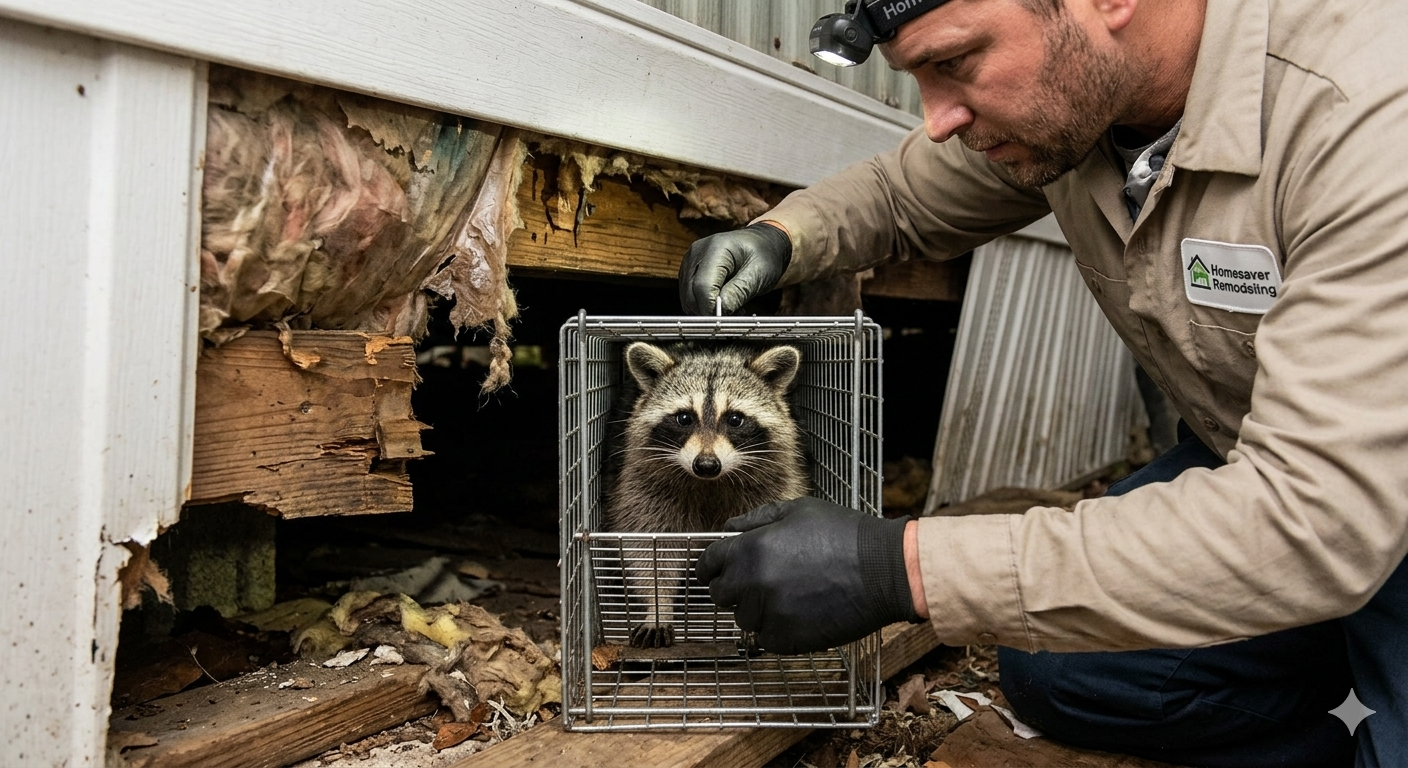
Manufactured homes offer wildlife exactly what they're looking for — a sheltered, insulated space close to the ground with multiple entry points that are easy to push through or chew open. Raccoons, squirrels, opossums, and rodents find their way into the crawlspace, belly wrap, and insulation of these homes regularly, and Michigan's cold winters make the problem worse. When temperatures drop, animals that might otherwise stay outside start looking for somewhere warm to nest.
Homesaver Remodeling handles wildlife damage repair in mobile and manufactured homes across Michigan. We assess the full scope of what the animal accessed, remove and replace contaminated materials, seal the entry points it used, and restore the home completely. If you're hearing something under your floor or noticing signs of animal activity, the right time to call is now — before the damage inside grows further.
Animals That Commonly Enter Manufactured Homes in Michigan
Raccoons
Raccoons are the most destructive common intruder in manufactured homes. They are strong enough to tear through belly wrap and skirting, large enough to cause significant structural damage while nesting, and they produce waste contamination that renders insulation and surrounding materials unusable. A raccoon that has been nesting beneath a home for several weeks can cause thousands of dollars in damage.
Squirrels
Squirrels enter through vents, gaps in skirting, and any small opening they can chew wider. They nest in insulation and chew through wiring, ductwork, and structural components. The wiring damage squirrels cause creates a genuine fire risk that needs to be assessed and addressed as part of any repair response.
Opossums
Opossums nest in insulation and crawlspace areas and produce significant waste contamination. They are less destructive structurally than raccoons but the materials they occupy require full replacement regardless of visible physical damage.
Rodents
Mice and rats enter through gaps as small as a quarter inch. They travel through wall cavities, ductwork, and insulation, and they chew wiring, vapor barriers, and structural materials throughout the home. Rodent activity is often present longer before it's detected, which means the damage tends to be more widespread by the time it's found.
Birds
Birds enter through vents and roof penetrations and build nests that block airflow and create fire hazards in ductwork. Vent caps that are missing or damaged after a storm are the most common access point.
The Damage Wildlife Leaves Behind
Contaminated Insulation
Insulation that has been occupied, nested in, or used as a waste site by any animal must be removed and replaced in full. There is no treatment that restores contaminated insulation to a safe and functional condition. Leaving it in place creates ongoing health risks and holds moisture against the structural components beneath the floor.
Compromised Belly Wrap and Vapor Barrier
Torn belly wrap exposes the home's underside to ground moisture, cold air, and further animal entry. A compromised vapor barrier allows ground moisture to rise into the insulation cavity and floor system. Both need to be replaced as part of a complete wildlife damage repair — not patched where the animal entered, but assessed across the full underside of the home.
Chewed Wiring
Rodents and squirrels chew through wiring insulation throughout the areas they travel. Exposed wiring is a fire hazard that doesn't announce itself before it becomes a problem. Any wildlife intrusion that involved these animals requires a wiring inspection.
Damaged Ductwork
Torn, disconnected, or contaminated ductwork reduces heating and cooling efficiency and, in the case of waste contamination inside the duct system, circulates air through a compromised space. Duct damage needs to be assessed across the full system, not just at the visible point of intrusion.
Why Removal Alone Is Not Enough
What Removal Leaves Behind
Wildlife removal addresses the animal. It does not address the insulation it nested in, the belly wrap it tore through, the entry points it used, or the wiring it may have chewed along the way. A home that has had an animal removed but not fully repaired is a home that still has contaminated materials, open entry points, and structural exposure — it just no longer has the animal.
The Contamination Problem
Materials that an animal occupied cannot be cleaned in place. Insulation, vapor barrier sections, and any structural material with significant waste contact need to be removed and replaced. Attempting to treat contaminated insulation rather than replace it leaves health risks in place and traps moisture against the floor system.
Unsealed Entry Points
Every entry point an animal used will be used again if it isn't sealed. Animals that are removed from a home and find the same access point available will re-enter. Other animals following scent trails will find and use the same openings. Entry point sealing is not optional — it is the step that determines whether the repair holds.
The Moisture Risk
Torn belly wrap and compromised vapor barrier left unaddressed after an animal intrusion create ongoing moisture exposure in the home's floor system. That moisture works against insulation, subfloor materials, and floor joists continuously. The structural damage that results from deferred belly wrap repair often exceeds the original cost of the wildlife damage itself.
What Homesaver's Emergency Wildlife Damage Response Involves
Removal Coordination
When live animals are still present, we coordinate with wildlife removal professionals to ensure the animal is out before repair work begins. We don't start the repair until the intrusion is resolved.
Full Damage Assessment
We trace everything the animal accessed — insulation, belly wrap, ductwork, wiring runs, structural components, and entry points — before any material removal or repair begins. The assessment determines the full scope of the job, not just what's visible at the surface.
Material Removal and Replacement
Everything the animal contaminated comes out. That includes:
- Insulation across the full area of occupancy
- Belly wrap sections that were torn or compromised
- Vapor barrier material with waste contact or moisture damage
- Duct sections that were damaged or contaminated
- Any structural material that was physically compromised
Structural and Wiring Repair
Subfloor sections, floor joists, and framing that were physically damaged by animal activity are repaired or replaced as part of the job. Wiring that shows evidence of chewing is flagged and addressed before the repair is closed out.
Entry Point Sealing
Every access point the animal used is identified and sealed as part of the job. This includes skirting gaps, vent openings, belly wrap entry points, and any other opening that allowed entry. Sealing is done with materials appropriate for manufactured home construction — not temporary patches.
Final Walkthrough
The job ends with a walkthrough confirming that contaminated materials have been removed, structural damage has been addressed, entry points are sealed, and the home is in a condition that won't invite a repeat intrusion.
Service Areas for Wildlife Damage Repair Across Michigan
Homesaver serves mobile and manufactured homeowners throughout:
- Macomb County — Shelby Township, Macomb Township, Clinton Township, and surrounding communities
- Oakland County — Waterford, Auburn Hills, Rochester, Orion Township, South Lyon
- Lapeer County — Davison and surrounding areas
- St. Clair County — Manufactured home communities throughout the county
- Wayne County — Manufactured homeowners across the metro area
Don't Let an Animal Intrusion Become a Structural Problem
An animal in your crawlspace or insulation is a repair job. An animal intrusion that goes unaddressed for a season is a contamination issue, a moisture problem, a potential mold situation, and a structural repair — all at once. The damage compounds because the conditions it creates don't resolve on their own.
The homeowners who come through wildlife intrusions with the most contained repair scope are the ones who called at the first sign — a sound under the floor, a smell that appeared without explanation, a section of skirting that looked wrong. Those early calls turn into straightforward jobs. The calls that come after a full winter of undetected nesting are a different conversation entirely.
📞 (586) 610-8608 🔗 homesaverremodeling.com