⚡ Fast Response | Expert Repairs | Trusted Service
MOBILE HOME REPAIRS
Water Damage & Plumbing Repairs
Mobile Home Mold Remediation & Emergencies
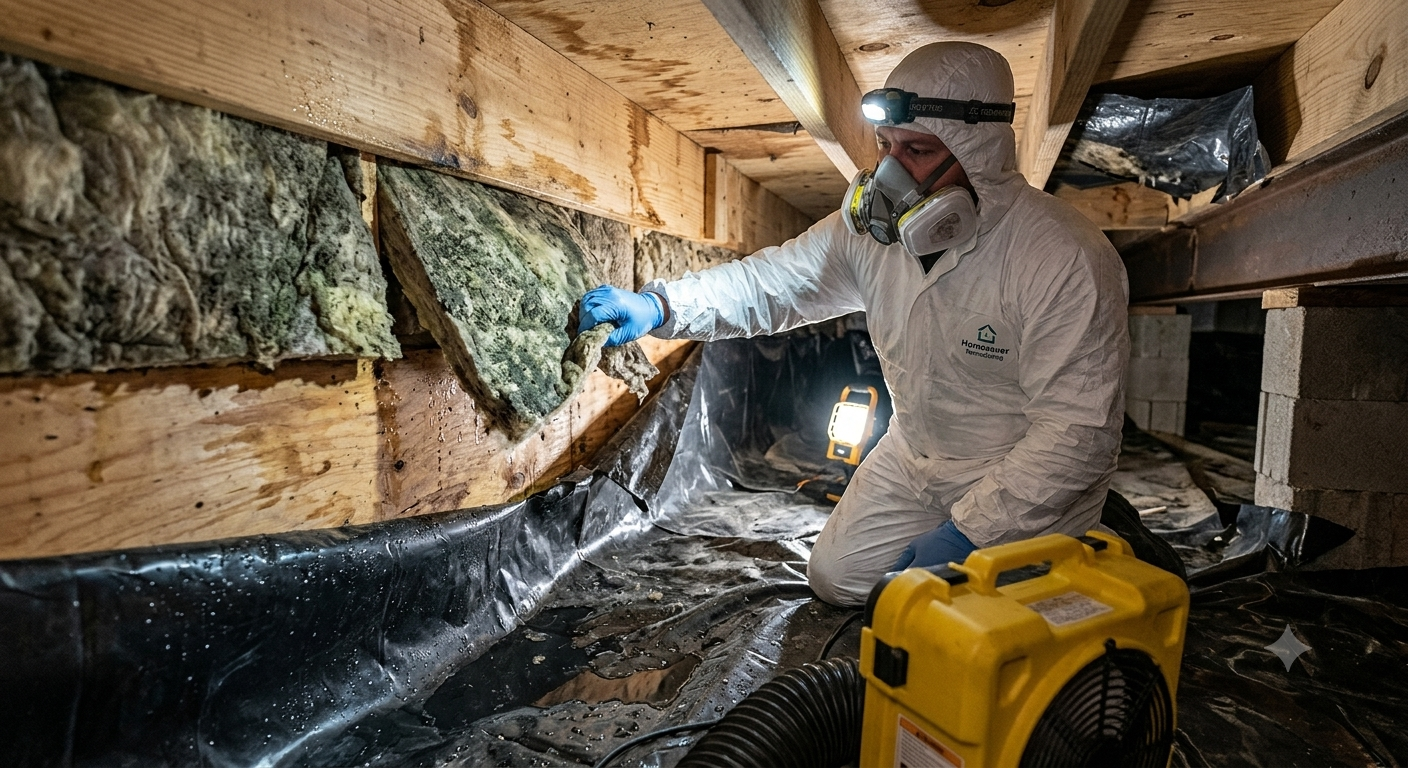
At Homesaver Remodeling, we provide specialized mold remediation services for manufactured homes across Michigan. Mold in a mobile home easily spreads through crawlspaces, subfloors, and wall cavities before it is even visible. Our team doesn't just clean up the mess—we inspect the full scope of the damage, safely contain and remove contaminated insulation and structural panels, and correct the underlying moisture source so the mold never comes back.
Mold in a manufactured home doesn't stay where it starts. It grows into the materials around it, moves through wall cavities and floor systems, and establishes itself in spaces that aren't visible from the living area — all while the homeowner may only notice a faint smell or a small stain on the wall. By the time mold becomes obvious, it has typically been active for weeks or months and traveled well beyond the visible signs.
The materials manufactured homes are built with create conditions that favor mold growth when moisture is present. Engineered wood subfloors, pressed board wall panels, and batt insulation absorb moisture readily and hold it long enough for mold to establish and spread. Michigan's climate compounds the problem — the freeze-thaw cycle, wet springs, and humid summers keep moisture conditions active across almost every season, and the crawlspace beneath a manufactured home is one of the most moisture-prone environments in residential construction.
Homesaver Remodeling handles mold remediation in mobile and manufactured homes across Michigan. Every job starts with finding the source.
Where Mold Hides in Manufactured Homes
The Crawlspace and Vapor Barrier
The crawlspace is the most common location for mold in manufactured homes and the hardest to detect from inside the living space. Ground moisture that bypasses a failing vapor barrier creates a persistently damp environment directly beneath the floor system. Mold that establishes in the crawlspace works upward into insulation and subfloor materials over time.
The Subfloor and Floor Joist Cavity
Moisture that reaches the subfloor — whether from below through the crawlspace or from above through a plumbing leak — creates mold-favorable conditions in the enclosed cavity between the floor surface and the belly wrap. This is one of the areas where mold causes the most structural damage, because the engineered wood subfloor degrades as the mold grows into it.
Wall Panel Interiors
Pressed board wall panels absorb moisture from both sides — from plumbing leaks inside the wall and from humidity conditions in the room. Mold that establishes inside a wall panel is not visible until the panel is removed, and by the time it produces a smell or visible sign at the surface, the framing behind it is often affected as well.
Ceiling Panels and Roof Leak Paths
Roof leaks introduce moisture at the top of the home that works downward through insulation and ceiling panels. Mold following this path can establish in ceiling materials, wall cavities, and eventually the floor system if the source goes unaddressed long enough.
Kitchen and Bathroom Areas
Slow plumbing leaks beneath sinks, behind tub surrounds, and under appliances create long-term moisture conditions in the cabinet bases and wall panels surrounding them. These are areas where mold is frequently found during inspection even when the leak itself has been repaired — because the materials around it were never dried or replaced.
The Health and Structural Risks of Untreated Mold
Health Risks
Mold produces spores and mycotoxins that circulate through the home's air supply. Respiratory symptoms, allergy responses, headaches, and fatigue are common in homes with active mold growth. Older adults, children, and people with existing respiratory conditions are most vulnerable, but prolonged exposure affects anyone living in a home with an unaddressed mold problem.
Structural Damage
Mold degrades the materials it grows in. Engineered wood subfloors lose structural integrity as mold works through them. Pressed board wall panels deteriorate from the inside. Insulation that has been colonized by mold loses its thermal performance and holds moisture against the framing it's meant to protect. The longer mold is active, the more of the home's structure it compromises.
The Cost Trajectory
The scope of a mold remediation grows with time. A mold problem caught at 30 days is a contained job — targeted material removal, source correction, replacement of affected components. The same problem at six months has typically spread through adjacent materials and may involve subfloor replacement, wall panel removal across a wider area, and crawlspace restoration. A problem that has been active across multiple seasons can become one of the most involved repairs a manufactured home requires.
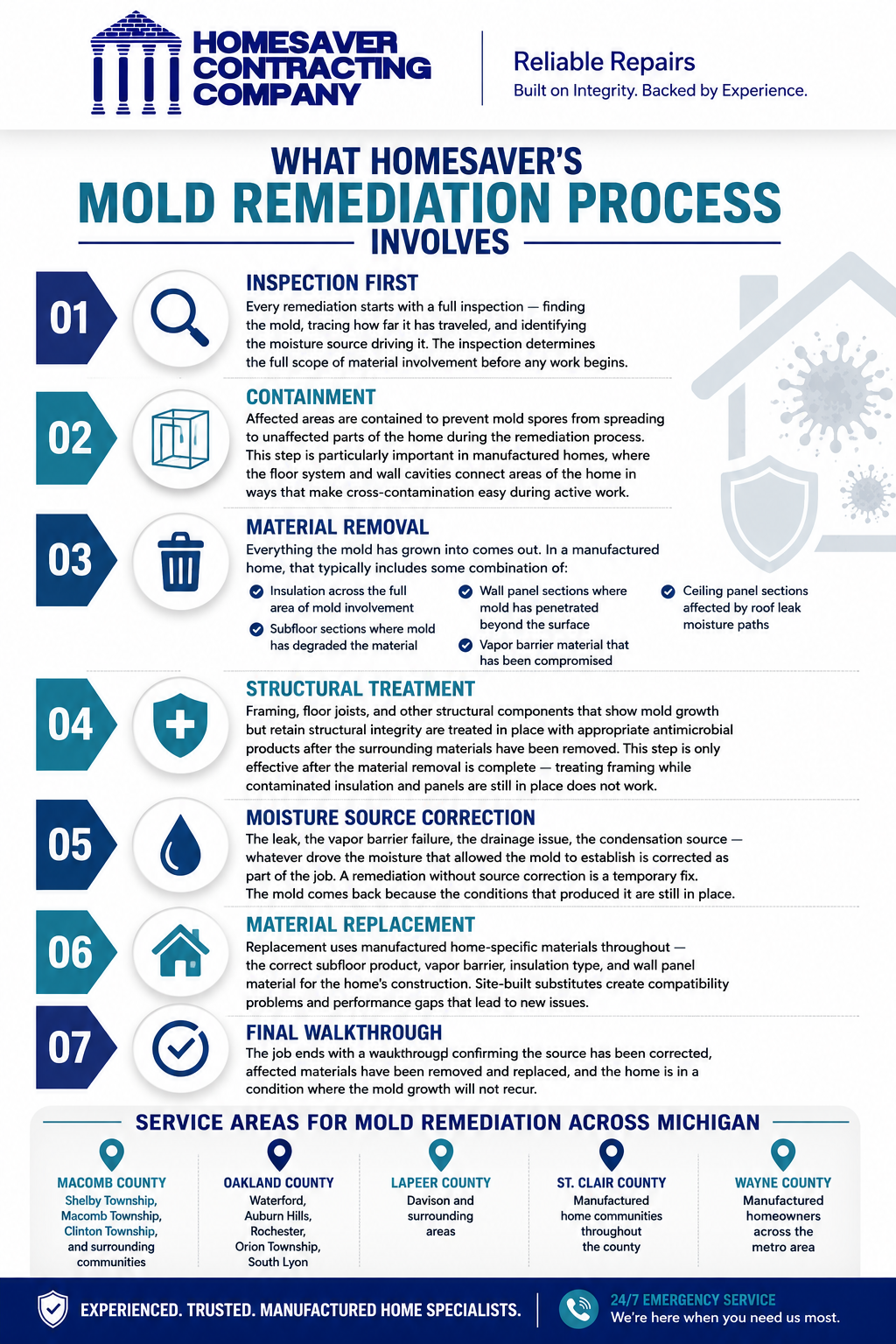
What Homesaver's Mold Remediation Process Involves
Inspection First
Every remediation starts with a full inspection — finding the mold, tracing how far it has traveled, and identifying the moisture source driving it. The inspection determines the full scope of material involvement before any work begins.
Containment
Affected areas are contained to prevent mold spores from spreading to unaffected parts of the home during the remediation process. This step is particularly important in manufactured homes, where the floor system and wall cavities connect areas of the home in ways that make cross-contamination easy during active remediation work.
Material Removal
Everything the mold has grown into comes out. In a manufactured home, that typically includes some combination of:
Insulation across the full area of mold involvement
Subfloor sections where mold has degraded the material
Wall panel sections where mold has penetrated beyond the surface
Vapor barrier material that has been compromised
Ceiling panel sections affected by roof leak moisture paths
Structural Treatment
Framing, floor joists, and other structural components that show mold growth but retain structural integrity are treated in place with appropriate antimicrobial products after the surrounding materials have been removed. This step is only effective after the material removal is complete — treating framing while contaminated insulation and panels are still in place does not work.
Moisture Source Correction
The leak, the vapor barrier failure, the drainage issue, the condensation source — whatever drove the moisture that allowed the mold to establish is corrected as part of the job. A remediation without source correction is a temporary fix. The mold comes back because the conditions that produced it are still in place.
Material Replacement
Replacement uses manufactured home-specific materials throughout — the correct subfloor product, vapor barrier, insulation type, and wall panel material for the home's construction. Site-built substitutes create compatibility problems and performance gaps that lead to new issues.
Final Walkthrough
The job ends with a walkthrough confirming the source has been corrected, affected materials have been removed and replaced, and the home is in a condition where the mold growth will not recur.
Service Areas for Mold Remediation Across Michigan
Macomb County — Shelby Township, Macomb Township, Clinton Township, and surrounding communities
Oakland County — Waterford, Auburn Hills, Rochester, Orion Township, South Lyon
Lapeer County — Davison and surrounding areas
St. Clair County — Manufactured home communities throughout the county
Wayne County — Manufactured homeowners across the metro area
Mold Does Not Resolve on Its Own
Mold in a manufactured home is not a cosmetic problem that can be cleaned, painted over, or monitored until it stabilizes. It is an active structural and air quality issue that gets worse as long as the moisture source feeding it remains in place. The materials in these homes don't give mold much resistance — and Michigan's climate doesn't give homeowners a long window between when a moisture problem starts and when mold becomes part of it.
The most important thing to understand about mold remediation is that the removal is only half the job. A home that has had mold cleaned or treated without source correction will have mold again. The conditions that produced it are still there. Finding and fixing the source is what makes a remediation last — and it's where a specialist who knows these homes makes the difference over a general contractor who doesn't.
If you've noticed a smell, a stain, soft flooring, or anything else that has you concerned, don't wait for a clearer sign. Call Homesaver and get a straight answer about what you're dealing with before the problem has more time to grow.